
27 Years After Armenia’s Parliament Attack, a Nation Still Reckons With the Leadership It Lost
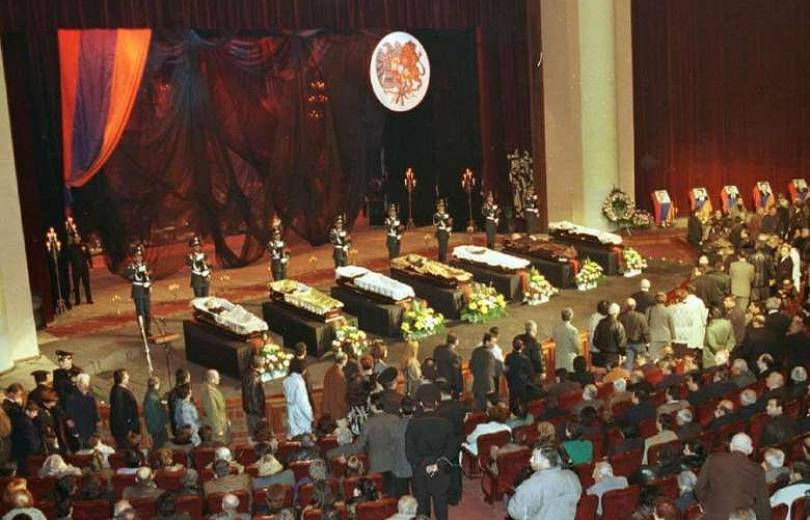
Twenty-seven years after gunmen assassinated eight officials inside Armenia’s parliament, the country continues to reckon with the loss of two of its most influential leaders — and persistent questions about whether everyone responsible was ever held accountable.
Prime Minister Vazgen Sargsyan and Parliament Speaker Karen Demirchyan had united a wartime commander’s influence with a veteran leader’s political following. Their Unity Alliance won the May 1999 parliamentary elections, emerging as the dominant force in Armenian politics.

Just months later, both men were dead.
On October 27, 1999, five armed men entered the National Assembly in Yerevan during a televised question-and-answer session with government ministers and opened fire. The attackers took lawmakers and officials hostage, holding them inside the building until surrendering the following day.
The killings left a sudden vacuum at the center of Armenia’s leadership. They also left a question that continues to invite reflection: What direction might the young republic have taken had those leaders survived?
There is no way to know. But understanding who they were, and the political partnership they had only recently built, helps explain why October 27 remains such a painful turning point in Armenia’s modern history.
Sargsyan had played a prominent military role during the First Nagorno-Karabakh War and became prime minister just months before the attack. Demirchyan, who had led Soviet Armenia for more than a decade, brought extensive governing experience and remained one of the country’s most popular political figures.
Their alliance brought two distinct sources of authority into a shared political project. Its electoral victory gave them a powerful position from which to shape Armenia’s future. The attack ended that partnership before its course could fully emerge.
Also killed were Deputy Parliament Speakers Yuri Bakhshyan and Ruben Miroyan; lawmakers Armenak Armenakyan, Henrik Abrahamyan and Mikael Kotanyan; and Minister for Operational Issues Leonard Petrosyan.
Together, the eight deaths represented a devastating loss across the country’s government and parliament.
For Armenians who witnessed the events, the anniversary is also a reminder of the people trapped inside the National Assembly as the attack unfolded.
In 2024, The Armenian Report interviewed journalist Anna Israyelyan, who was inside parliament when the gunmen opened fire. Her firsthand account offers a direct connection to the events of October 27 — particularly for younger Armenians and diaspora readers who know the attack primarily through archival footage and family recollections.
Her testimony brings the story back to the people who lived through it: those who entered parliament for a working day and instead witnessed the assassination of the country’s leaders.
The gunmen were led by Nairi Hunanyan, a former journalist. His brother Karen Hunanyan, their uncle Vram Galstyan and two other armed men participated in the attack.

On December 2, 2003, following a trial that lasted several years, an Armenian court sentenced six defendants to life imprisonment. A seventh received a 14-year sentence.
The convictions established criminal responsibility for the defendants. But questions about whether others helped organize or direct the attack have persisted for decades. The existence of those questions does not establish the involvement of any additional person, and allegations surrounding the killings must be distinguished from proven findings.
That gap between punishment and a broadly accepted account of the attack’s origins remains part of its painful legacy.
For Armenians at home and across the diaspora, remembering October 27 means confronting both what happened and what can never be answered. The eight officials left behind families, colleagues and unfinished work. Armenia lost leaders whose decisions might have shaped a different political future, although what that future would have looked like remains unknowable.
Twenty-seven years later, their lives deserve remembrance alongside the circumstances of their deaths.
The Armenian Report’s 2024 interview with survivor Anna Israyelyan offers an opportunity to revisit that history through the account of someone who was there.
—
Support independent reporting from the region by subscribing to The Armenian Report. Our team is funded solely by readers like you.


Comments