
A Complete Election Day Recap: Everything That Happened Before the Polls Closed and What You Need to Know Before the Results
- Jun 7
- 4 min read
Updated: Jun 8

Armenians voted Sunday in one of the country's most consequential parliamentary elections since the 2018 Velvet Revolution, with voters choosing between Prime Minister Nikol Pashinyan's ruling Civil Contract party and a fragmented opposition seeking to end his eight-year hold on power.
Polling stations opened at 8 a.m. and closed at 8 p.m. across the country. More than 2.4 million citizens were registered to vote in an election closely watched by domestic observers and the international community during ongoing peace negotiations with Azerbaijan, growing geopolitical tensions and deep political polarization at home.
Eighteen political parties and alliances competed for seats in the National Assembly after one political force was removed from the ballot by the Central Electoral Commission.
Throughout the day, The Armenian Report’s Ani Khachatryan visited polling stations in Yerevan and other communities, documenting the voting process, speaking with voters and observing election administration as Armenia chose its next prime minister.

The leaders of the four political forces widely viewed as the election's frontrunners cast their ballots within roughly half an hour of one another before midday.
Prime Minister Nikol Pashinyan arrived alone at his polling station wearing the orange map of Armenia symbol associated with the Civil Contract party despite election authorities urging candidates to avoid clothing or accessories that could be linked to participating political forces.

"The people, when making their choice, should be guided by the need to protect the state, independence, the future, peace, and the achievements of the revolution for their children," Pashinyan said.
The prime minister said he was prepared to accept any outcome of the election, including a return to the opposition.
Strong Armenia Alliance leader Samvel Karapetyan, who remains under house arrest, arrived accompanied by law enforcement officers and publicly revealed his voting preference while receiving his ballots.

Former President Robert Kocharyan, leading the Armenia Alliance, again argued that whichever opposition force receives the most votes should nominate the prime ministerial candidate. Asked whether Pashinyan would peacefully leave office if defeated, Kocharyan warned that refusal to do so would end "very badly" for the prime minister.
Prosperous Armenia Party leader Gagik Tsarukyan declined to reveal whom he would support for prime minister but expressed confidence in his party's prospects and dismissed government allegations regarding the origins of his wealth.
Foreign policy emerged as one of the dominant themes of election day, reflecting broader debates that shaped the campaign.
Pashinyan said he intends to continue engagement with Moscow, Brussels and Washington following the election while also expressing hope of attending the next European Political Community summit in Baku.
He rejected claims of a crisis in Armenian-Russian relations despite recent Russian restrictions affecting Armenian exports and imports.
Kocharyan sharply criticized the government's foreign policy direction, warning that Armenia risked damaging its strategic ties with Russia while receiving little in return from Western partners. Karapetyan advocated what he described as a balanced foreign policy, while Tsarukyan argued that Armenia's current tensions with Moscow were the result of inconsistent diplomacy.
As voting continued, opposition parties raised concerns about searches, detentions and alleged pressure on supporters.

Karapetyan claimed dozens of supporters had been detained in the days leading up to the election, including on voting day itself. Kocharyan described the situation as unprecedented and accused authorities of targeting opposition figures through criminal investigations and surveillance.
The ruling Civil Contract party rejected those accusations. Campaign headquarters chief Arayik Harutyunyan said individuals detained by law enforcement were suspected of criminal offenses rather than political activity and insisted there was no political persecution.
According to Armenia's Anti-Corruption Committee, 194 people were detained and criminal proceedings were launched against 209 individuals in connection with alleged election-related offenses.
Reports of detentions and searches emerged from multiple regions throughout the day.
Representatives of the Armenia Alliance said supporters were taken from their homes during the early morning hours. In Gyumri, police detained several individuals on suspicion of distributing election bribes. Lawyers and opposition representatives accused law enforcement of restricting access to detainees, while police maintained they were acting within the law.
Election day was also marked by several technical and procedural issues at polling stations.
At Polling Station 9/51 in central Yerevan, voting was temporarily disrupted shortly after opening when voter-identification machines generated receipts that did not correspond with registry records. The issue delayed voting for more than half an hour before election officials implemented a temporary workaround allowing voters to locate their names manually.
Several voters expressed frustration over the malfunction.
At another polling station, a voter discovered that someone had already signed next to his name in the registry. Election officials documented the incident and allowed the individual to vote.
There were also complaints from voters who found unfamiliar names registered at their addresses, reports of incomplete ballot packages being issued, and concerns about ballot secrecy at one polling station where a voting booth had been positioned in a way that allowed others to observe voters. Election officials later repositioned the booth after concerns were raised.
Despite the incidents, voting generally proceeded peacefully throughout the day.
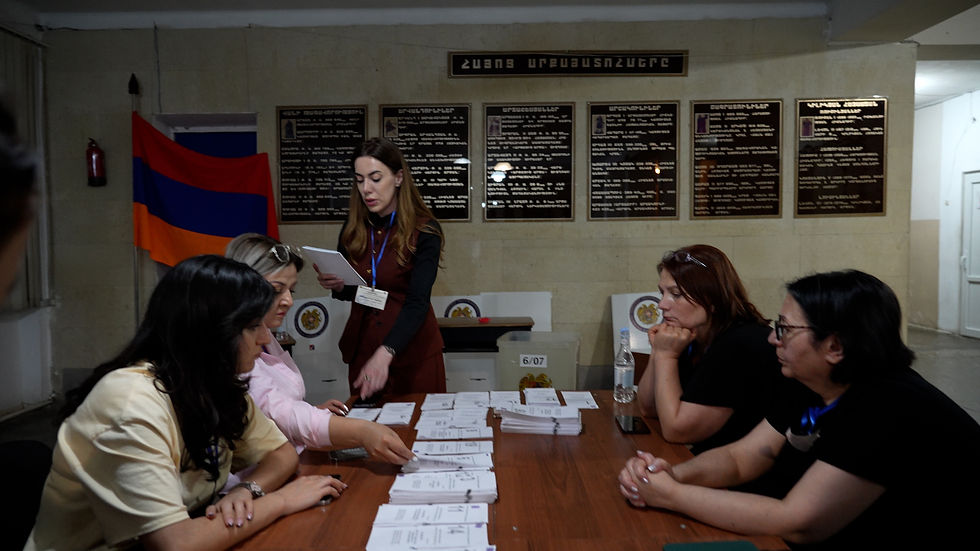
Long lines formed at numerous polling stations across Yerevan, with turnout appearing strong in several districts. In some schools housing multiple polling stations, queues extended into shared hallways as voters waited to cast their ballots.
Election officials were frequently observed assisting elderly voters and first-time participants unfamiliar with the voting process.
Amid the political tensions, some lighter moments also emerged. At one polling station, a bride and groom stopped to cast their ballots before heading to their wedding ceremony.
The election follows one of Armenia's most contentious campaigns in recent years.
The race unfolded against the backdrop of ongoing peace negotiations with Azerbaijan, disputes over Armenia's geopolitical orientation between Russia and the West, economic concerns, and continuing debates over responsibility for the country's military and territorial losses in recent years.
Campaigning officially ended on June 5 before the country entered a legally mandated day of silence ahead of voting.
As polling stations closed Sunday evening, attention shifted to the vote count and whether the results would provide a clear mandate for a government or lead to a prolonged political struggle in a country that remains deeply divided over its future direction.
—
Support independent reporting from the region by subscribing to The Armenian Report. Our team is funded solely by readers like you.


.png)


Comments