
Pashinyan Declares Peace With Azerbaijan, Acknowledges Fate of Armenian POWs Remains Unresolved

Armenian Prime Minister Nikol Pashinyan said Friday that peace with Azerbaijan has become a reality after more than three decades of conflict, but acknowledged that the fate of Armenian detainees, missing persons and other humanitarian concerns remains unresolved.
Speaking at a Commonwealth of Independent States (CIS) summit in Turkmenistan on October 9, Pashinyan pointed to the U.S.-brokered agreement initialed by Armenia and Azerbaijan at the White House on August 8, 2025, as a turning point in relations between the two countries.
The agreement, reached during a summit hosted by President Donald Trump, commits Armenia and Azerbaijan to recognizing each other's sovereignty, territorial integrity and existing borders. Both sides also agree not to pursue territorial claims against one another.
Although the document has yet to be formally signed and ratified, Pashinyan said the progress achieved since the Washington summit demonstrates that the two countries have moved beyond decades of armed confrontation.
He credited Azerbaijani President Ilham Aliyev and international partners for helping secure what he described as a previously unimaginable breakthrough.
“We have achieved the impossible,” Pashinyan said, urging both governments to protect the peace for future generations.
The prime minister, however, conceded that the current situation falls short of a complete settlement. Among the outstanding issues, he identified people still held in detention, the search for those missing from previous wars and the removal of landmines.
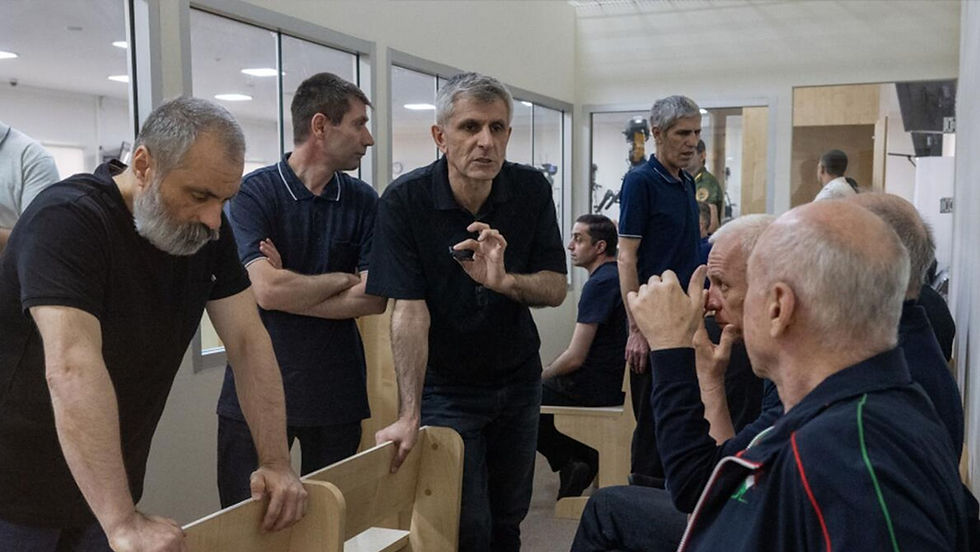
The detention of Armenians in Azerbaijan remains one of the most sensitive issues in relations between Yerevan and Baku. Armenian prisoners, including former political and military leaders of Nagorno-Karabakh, known to Armenians as Artsakh, remain in Azerbaijani custody following Baku's September 2023 military offensive.
That operation brought the territory under Azerbaijan's full control and forced more than 120,000 ethnic Armenians to flee to Armenia.

Pashinyan has previously called for the return of Armenian detainees, including during his September address to the United Nations General Assembly.
Turning to security developments, Pashinyan said neither country has recorded deaths or injuries from cross-border exchanges of fire for more than two years. He also reported that a 12-kilometer (7.5-mile) section of their shared border has been delimited and demarcated.
Economic contacts have also begun to expand. According to the prime minister, Azerbaijan's railway network has been available for Armenian cargo for nearly a year, and bilateral trade has started.
Pashinyan traced the diplomatic foundation of the peace process to the 1991 Alma-Ata Declaration, signed following the collapse of the Soviet Union. The declaration established the principle that former Soviet republics would respect one another's territorial integrity and existing borders.

Those principles now form the basis of the Armenian-Azerbaijani peace agreement and the border delimitation process.
Pashinyan acknowledged that the declaration did little to prevent the conflict from escalating during the previous three decades. He argued that both governments had to return to its original principles to establish a workable framework for peace.
He also recognized Russian President Vladimir Putin's role in brokering the November 2020 ceasefire that ended the 44-day war between Armenia and Azerbaijan.
Another important step, he said, came in October 2022, when Armenia and Azerbaijan reaffirmed the Alma-Ata principles during a meeting in Prague attended by French President Emmanuel Macron and then-European Council President Charles Michel.
Beyond the diplomatic negotiations, Pashinyan outlined plans to restore transportation links across the South Caucasus through the Trump Route for International Peace and Prosperity, or TRIPP.
The U.S.-backed project would establish a transportation connection between mainland Azerbaijan and its Nakhchivan exclave through southern Armenia. It would also give Armenia access to routes connecting its northern and southern regions through Nakhchivan.
Pashinyan said the arrangements would respect the sovereignty, territorial integrity and jurisdiction of the countries involved.
The proposed infrastructure could eventually support railway connections between the Persian Gulf and the Black Sea through Iran, Nakhchivan, Armenia and Georgia, while expanding trade routes linking Europe and Asia.
He also expressed hope that Armenia's long-closed border with Turkey would reopen and that railway and road connections between the two countries would be restored.
Despite the remaining disputes, Pashinyan maintained that the progress made since the Washington summit has created an opportunity to establish lasting relations between Armenia and Azerbaijan.
The next major diplomatic step remains the formal signing and ratification of the peace agreement, while the unresolved humanitarian issues continue to test the relationship between the two neighbors.
—
Support independent reporting from the region by subscribing to The Armenian Report. Our team is funded solely by readers like you.


.png)
Comments