
Remembering Hrant Dink at 72: The Journalist Who Dared Turkey to Confront the Armenian Genocide

Hrant Dink, the Turkish-Armenian journalist who became one of Turkey’s most prominent voices for democracy, minority rights and honest dialogue about the Armenian Genocide, would have turned 72 on Sept. 15. He was assassinated in Istanbul in 2007.
Dink was born September 15, 1954, in Malatya, eastern Turkey. After his parents separated, he and his brothers spent part of their childhood at an Armenian orphanage in Istanbul. Those early experiences shaped a life closely tied to Turkey’s Armenian community and its struggle to preserve its identity.
In 1996, Dink helped establish Agos, a bilingual Armenian-Turkish weekly newspaper that broke new ground in Turkey. As its editor-in-chief, he brought issues affecting the country’s Armenian minority into the broader public debate while writing openly about democracy, discrimination, freedom of expression and the Armenian Genocide.
Dink believed Turkey could not build a democratic future without confronting its past. At the same time, he rejected hostility between Armenians and Turks, arguing that the two peoples needed direct dialogue and a chance to understand one another beyond the political and historical divisions separating them.
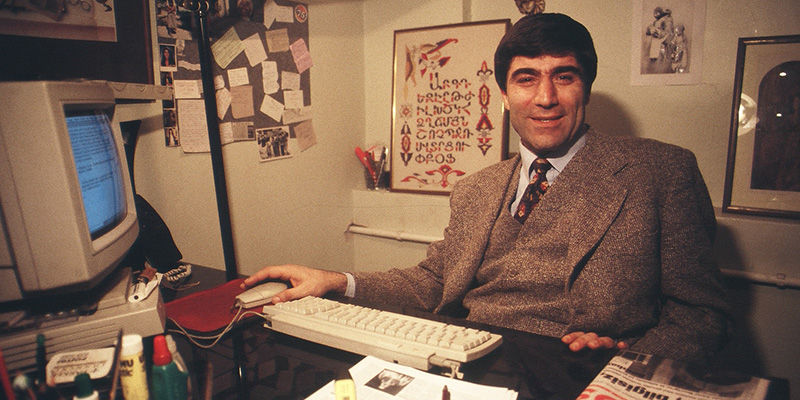
He also advocated closer relations between Armenia and Turkey, which have never established full diplomatic relations and whose land border has remained closed for decades.
His journalism came at a heavy cost.
Dink became the target of nationalist groups and faced repeated legal action over his writings. He was prosecuted under Article 301 of Turkey’s Penal Code, which criminalized “insulting Turkishness,” and in 2005 received a suspended six-month prison sentence.
The prosecution drew international criticism and made Dink a prominent symbol of the fight for free expression in Turkey. He also faced an increasingly hostile campaign in nationalist media and received death threats.
On Jan. 19, 2007, Dink was shot dead outside the Agos offices in Istanbul’s Şişli district. He was 52.
His killing stunned Turkey. At his funeral, hundreds of thousands of people filled the streets of Istanbul. Many carried signs reading, “We are all Hrant, we are all Armenians,” a phrase that became one of the most recognizable expressions of solidarity with Turkey’s Armenian community.
Dink had written about the threats against him shortly before his death. In one of his final articles, he described feeling frightened and isolated as nationalist pressure intensified around him.
The circumstances surrounding his assassination and the failure of Turkish authorities to protect him would remain the subject of years of court proceedings. In 2010, the European Court of Human Rights ruled that Turkey had failed to take reasonable measures to protect Dink despite authorities having information about a plot against him. The court also found violations related to his freedom of expression.
The site where Dink worked and was killed has since become a place of remembrance. The former Agos offices in Istanbul’s Sebat building now house the 23.5 Hrant Dink Site of Memory, dedicated to his life, journalism and struggle for human rights.
His work also continues through the Hrant Dink Foundation, established after his death to promote democracy, equality, cultural dialogue and reconciliation.
Nearly two decades after his assassination, Dink remains one of the most recognizable Armenian voices to have emerged from modern Turkey. His writings continue to resonate in debates over the Armenian Genocide, the rights of Turkey’s minorities and the limits of free speech.
For many Armenians, his significance went beyond journalism. Dink spoke publicly about an identity and history that generations of Armenians in Turkey had often been forced to discuss cautiously. For many Turks, he offered a different way of confronting that history — through dialogue rather than denial or hostility.
Hrant Dink would have turned 72 on Sept. 15.
—
Support independent reporting from the region by subscribing to The Armenian Report. Our team is funded solely by readers like you.




Comments