
Senior U.S. Officials Meet Pashinyan in Yerevan to Advance TRIPP Corridor Project
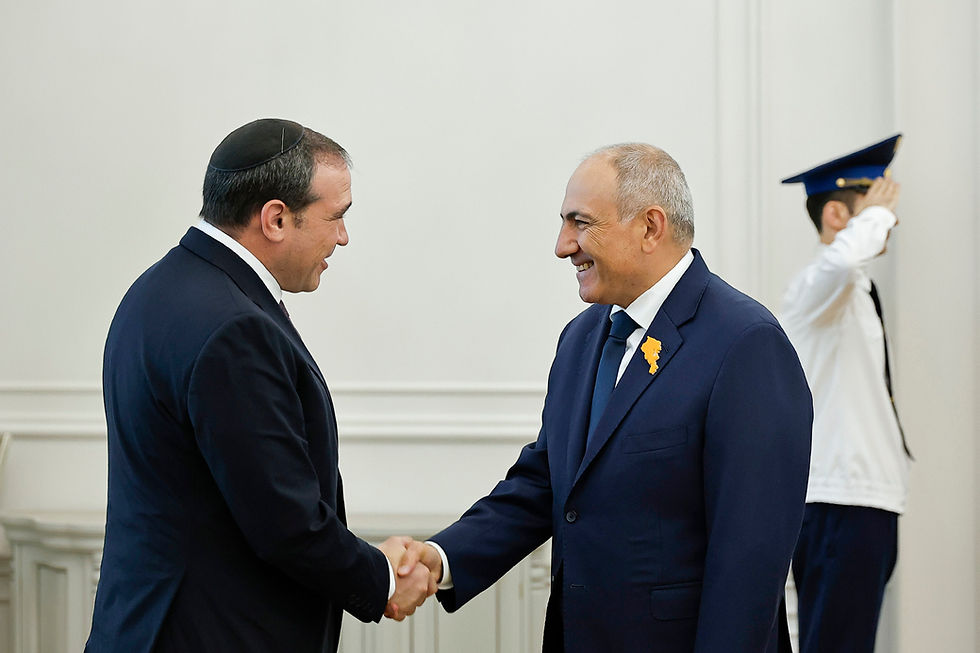
U.S. Special Envoy Steve Witkoff's Senior Adviser Aryeh Lightstone met with Armenian Prime Minister Nikol Pashinyan in Yerevan on Wednesday to discuss progress on the Trump Route for International Peace and Prosperity (TRIPP) project. Also present at the meeting were Konstantin Sokolov, head of the U.S.-backed TRIPP investment fund, and Ambassador of the United States to Armenia David Allen.
According to the Armenian government, the discussions focused on implementing the U.S.-backed infrastructure initiative, which would connect Azerbaijan with its Nakhijevan exclave through southern Armenia. The participants reviewed the remaining technical issues that must be resolved before construction can begin.
In a brief statement, the Prime Minister's Office said both sides agreed that once those outstanding matters are settled, visible progress on the project should begin in the near future. No additional details were released.

Lightstone currently serves as senior adviser to Steve Witkoff and the Peace Missions office, where he supported Witkoff during negotiations that led to the TRIPP Accords between Armenia and Azerbaijan. He also plays a role in implementing President Donald Trump's broader peace initiatives, including efforts related to the conflict in Gaza.
A longtime U.S. diplomat and adviser, Lightstone previously served as senior adviser to the U.S. ambassador to Israel from 2017 to 2021. In 2020, he was appointed Special Envoy for Economic Normalization for the Abraham Accords, helping lead the Peace to Prosperity team. In that role, he directed the Abraham Fund, led the inaugural Abraham Accord Business Summit and helped advance implementation of the historic agreements. He received honors from the U.S. Department of Defense, the U.S.
Department of State and the State of Israel for his work promoting U.S. interests and regional peace in the Middle East.

In January 2026, President Donald Trump, chairman of the Board of Peace, appointed Lightstone as senior adviser to the board. He is also the author of the book “Let My People Know”, which focuses on the Abraham Accords.
Lightstone also held separate talks with Armenian Foreign Minister Ararat Mirzoyan. Both sides emphasized the importance of launching the project as soon as possible. The U.S. Embassy in Yerevan had not publicly commented on the meetings as of Wednesday evening.
Sokolov, a Russian-born American entrepreneur, was recently appointed by the U.S. State Department to lead a $200 million investment fund created to support the development of the corridor. He also has business interests in Armenia, including a major stake in one of the country's three mobile phone operators.
The meetings come two months after the United States and Armenia signed an agreement establishing the framework for the ambitious project.

The agreement calls for the creation of the TRIPP Development Company, a joint venture that will oversee the construction and operation of a railway, highway, power lines and other infrastructure stretching along Armenia's border with Iran for at least 49 years.
Under the agreement, the U.S. government will hold a 74% stake in the company, which will receive exclusive land-use and development rights needed to build and manage the corridor.
The project has drawn strong criticism from Iran, which says it is concerned the initiative could increase U.S. influence along the Armenia-Iran border and eventually weaken Armenia's control over the strategically important route.
On July 8, Iran's Ambassador to Armenia Mehdi Sobhani said Yerevan had not yet addressed Tehran's "very legitimate and logical" concerns about the project.
The following day, Pashinyan reaffirmed his government's commitment to moving forward with TRIPP as quickly as possible.
Speaking to reporters on July 30, Pashinyan said Armenia is ready to answer all of Iran's questions in an effort to ease its concerns.
Despite those assurances, opposition leader Levon Zurabyan said after a recent visit to Tehran that Iranian officials remain firmly opposed to the initiative. Citing unnamed Iranian officials, Zurabyan said they warned that if the corridor is ultimately seen as a threat to Iran's national security, Tehran would respond accordingly.
—
Support independent reporting from the region by subscribing to The Armenian Report. Our team is funded solely by readers like you.




Comments