
Armenian Genocide Memorial Destroyed in Stepanakert as Experts Warn of Systematic Erasure Under Azerbaijan’s Occupation of Nagorno-Karabakh

A senior cultural heritage official from Artsakh has raised concern over new evidence showing the destruction of an Armenian memorial in Stepanakert, warning that the incident is part of a wider pattern targeting Armenian historical and cultural sites.
Hovik Avanesov, the Ombudsman for the Cultural Heritage of Artsakh and Vice President of the “National” Historical and Cultural NGO, says new documentation points to the complete removal of a monument dedicated to the 100th anniversary of the Armenian Genocide. The monument was located inside a memorial complex in Stepanakert and held strong symbolic meaning.
According to documentation by Caucasus Heritage Watch, the destruction cannot be seen as a single or isolated act. The findings suggest a consistent policy aimed at removing Armenian cultural heritage and erasing historical memory from the area.
The monument included a white marble bell tower and a reliquary containing human remains brought from Deir ez-Zor. This location holds deep importance in Armenian history, as it is widely remembered as one of the main sites connected to the final stages of the Armenian Genocide, where large numbers of Armenians were killed or died during forced marches.
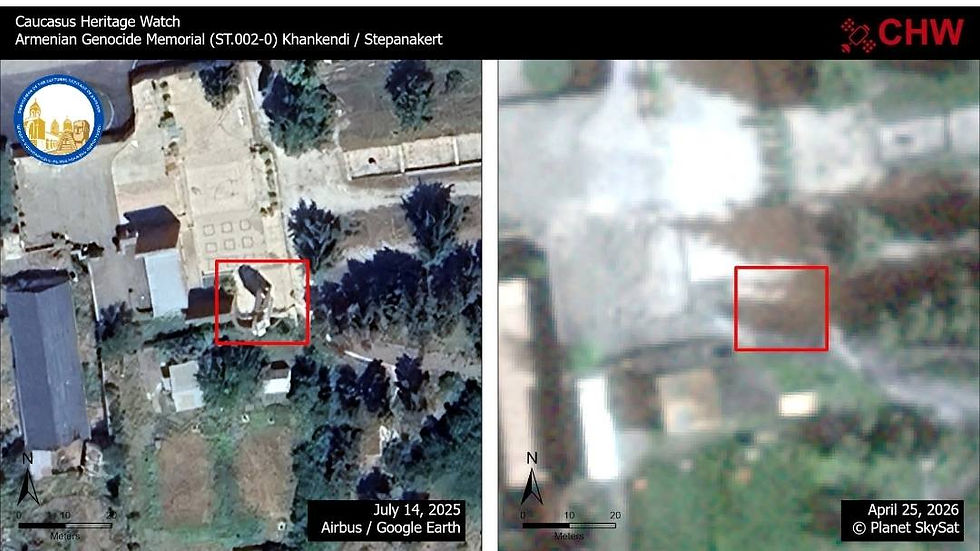
The removal of the monument is being described as more than just the loss of a structure. It is seen as a direct impact on historical memory, the remembrance of victims, and the identity of future generations connected to that history.
Satellite images from Airbus and Planet Labs show that the destruction of the monument and the surrounding memorial complex took place over a period of time, between July 14, 2025, and April 25, 2026. This timeline suggests that the process was not accidental, but planned and carried out in stages, with the goal of clearing the area of any visible Armenian presence.
Experts say such actions should be viewed in the context of international law, especially rules related to the protection of cultural heritage. The destruction of cultural sites is considered a violation of several international agreements, including those supported by UNESCO. Despite this, similar cases continue to be reported, often without consequences.
The case is also being described as having political and ideological meaning. By removing visible signs of Armenian history, it may change how the area is understood and remembered in the future. Observers say this reflects a broader effort to reshape the historical narrative of the region.
The destruction of the Stepanakert memorial is therefore being seen not as a single event, but as part of a larger and ongoing process. It highlights concerns about the preservation of cultural heritage and raises questions about the need for a stronger international response.
—
Support independent reporting from the region by subscribing to The Armenian Report. Our team is funded solely by readers like you.


.png)
Comments