
Armenia's New Parliament Opens With Historic Church Snub, Opposition Clashes, and Pashinyan's Fourth Appointment as Prime Minister

Armenia’s newly elected National Assembly opened its first session Sunday following the June 7 parliamentary elections, beginning a new legislative term with sharp exchanges between the governing majority and opposition lawmakers.
The day also brought the formal reappointment of Prime Minister Nikol Pashinyan and the unprecedented absence of Catholicos Karekin II, who was not invited to address the opening session.
The 105-seat parliament convened at 10 a.m. under Armenian law. Knyaz Hasanov, the chamber’s oldest lawmaker, chaired the proceedings pending the election of a speaker.
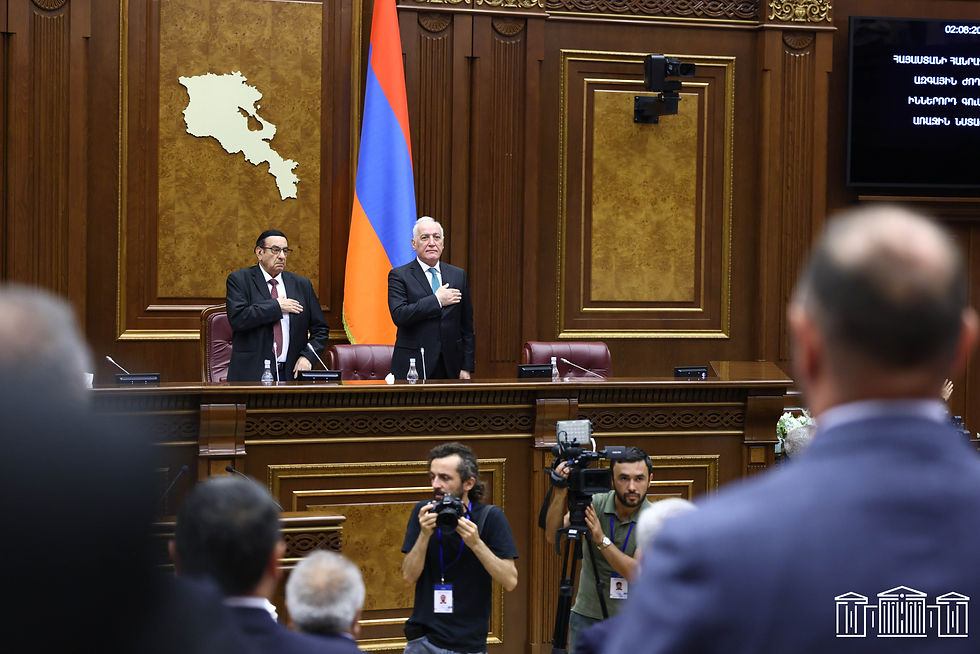
President Vahagn Khachaturyan attended alongside members of all three parliamentary factions. After the national anthem, he called on lawmakers to prevent political disagreements from becoming personal hostility.
“The public expects the National Assembly to be a place where different political views do not deepen divisions, but compete to offer solutions that are most useful to the state,” Khachaturyan said.
He said the government and opposition ultimately serve the same goal — the advancement of Armenia — and urged both sides to demonstrate restraint, foresight and a willingness to cooperate.
Catholicos Karekin II did not attend the opening — the first time in independent Armenia’s history that the head of the Armenian Apostolic Church was absent from the inaugural session of a newly elected parliament.

Under parliamentary rules, both the president and the Catholicos have the right to deliver welcoming remarks at the opening sitting. Church officials said Karekin II did not receive an invitation.
His absence quickly became a point of confrontation.
After Khachaturyan’s speech, Strong Armenia faction leader Narek Karapetyan called out from his seat: “Mr. President, where is the Catholicos of All Armenians?”
The president did not respond. Karapetyan repeated the question as other opposition lawmakers joined him, prompting Hasanov to urge them not to disrupt the session.
The two opposition factions did not applaud the president’s address. They also remained seated as Hasanov read the parliamentary oath, although their members later signed it.
Pashinyan’s Civil Contract party controls 64 seats in the new parliament, enough to govern without a coalition.

The Strong Armenia alliance, associated with Russian-Armenian billionaire Samvel Karapetyan, holds 29 seats. Former President Robert Kocharyan’s Armenia Alliance has 12.
Neither Karapetyan nor Kocharyan will serve as a lawmaker. Karapetyan is barred from taking a seat under Armenian law, while Kocharyan declined his mandate.
Civil Contract selected Arusyak Manavazyan as its faction leader. Narek Karapetyan leads Strong Armenia, while Anna Grigoryan heads the Armenia Alliance faction.
One deputy speaker position and the chairmanships of four standing committees are reserved for the opposition.
Strong Armenia nominated lawyer Aram Vardevanyan for deputy speaker. Narek Karapetyan said the choice was based on Vardevanyan’s experience, professionalism and legal background.
Rubinyan Nominated for Speaker
Civil Contract nominated former Deputy Speaker Ruben Rubinyan to lead the new parliament. He was the only candidate put forward Sunday.

In his address, Rubinyan acknowledged the deep mistrust between the governing party and the opposition and urged lawmakers to avoid turning the chamber into another arena for insults and personal attacks.
He said the hostility between the two sides had roots in the opposition’s rejection of the 2018 Velvet Revolution and intensified after the 2021 elections.
Rubinyan proposed what he described as a fresh start, calling for forceful but respectful political debate.
He also warned that Civil Contract would respond differently if the opposition rejected that approach, saying the governing party was prepared to return to its previous methods “in the strongest sense of the word.”
Fourteen lawmakers registered to question him.
Strong Armenia MPs focused several questions on Rubinyan’s time studying in Turkey, asking whether he had interacted or formed friendships with Turkish citizens. Rubinyan said he had communicated with Turks but had not developed close personal relationships.

Armenia Alliance lawmakers pressed him on the future of Tigranashen, asking whether he could guarantee the village would not be transferred to Azerbaijan.
Rubinyan replied that no part of Armenia’s sovereign territory could be surrendered.
As required by the Constitution, Pashinyan submitted his government’s resignation when the new parliament began its term.
Civil Contract then formally nominated him for another term as prime minister and submitted the necessary documents to the president.
Khachaturyan accepted the government’s resignation before signing a decree reappointing Pashinyan later Sunday.
During a meeting at the presidential residence, Khachaturyan congratulated Pashinyan and wished him patience, resilience and determination as he leads the country through what he described as difficult times.

Pashinyan said Armenia’s political path since 2018 had been far more difficult than anyone could have predicted.
“When I assumed the office of prime minister in 2018 following the peaceful, nonviolent Velvet Revolution, it would have been difficult to foresee the road we would travel,” he said.
He credited the Armenian public with sustaining the country through years of political and security crises and said the renewed mandate placed a significant responsibility on the government.
Pashinyan also said he hoped the new parliament would become a place for competing political ideas rather than personal attacks, insults and targeted accusations.
Khachaturyan said democratic stability depends not only on the strength of the governing majority but also on the quality of the opposition.
One of the few moments of unity came after Strong Armenia lawmaker Edgar Ghazaryan criticized parliamentary leaders for failing to open the session with a tribute to those killed in Armenia’s wars and military operations.

Ghazaryan recalled that lawmakers observed a minute of silence at the opening of the previous parliament in 2021. He called the omission Sunday a serious breach of moral responsibility.
From the podium, he asked lawmakers to stand in memory of soldiers, officers, generals, volunteers and others killed defending Armenia and Artsakh.
Every lawmaker in the chamber — from both the governing party and the opposition — rose for the tribute.
Parliament completed only the formation of its Counting Committee before adjourning.
The first session will continue Monday with the election of the speaker and deputy speakers, the formation of standing committees, the selection of committee chairs and debate over the structure and program of the new government.
—
Support independent reporting from the region by subscribing to The Armenian Report. Our team is funded solely by readers like you.




Comments