
Bipartisan U.S. Lawmakers Demand Release of Armenian POWs and Right of Return to Artsakh

A bipartisan group of U.S. lawmakers called on Azerbaijan to release Armenian prisoners held in Baku and allow Armenians displaced from Artsakh to return to their homes, bringing the unresolved humanitarian consequences of the 2023 exodus back into focus on Capitol Hill.
A dozen members of Congress joined Armenian American advocates, clergy and human rights experts Tuesday for “Accountability | 2026 — Artsakh: Justice. Freedom. Right of Return,” a Capitol Hill program organized by the Armenian National Committee of America, or ANCA.
The gathering came three years after Azerbaijan's September 2023 military offensive in Nagorno-Karabakh, known to Armenians as Artsakh. More than 100,000 ethnic Armenians fled the region for Armenia in the days that followed.
ANCA said the event capped two days of meetings in Washington involving more than 100 Armenian American advocates from over 30 states. The organization said delegations reached all 435 House and 100 Senate offices as they pressed lawmakers on the prisoners, the right of return, Armenian cultural heritage and U.S. policy toward Azerbaijan.
Rep. Brad Sherman, D-Calif., vice chair of the Congressional Armenian Caucus, called for the prisoners' release and criticized the proceedings against Armenian defendants in Azerbaijan.
“The war is over. It's time to release the prisoners of war,” Sherman said.
Sherman pointed to action by the House Foreign Affairs Committee, which previously approved an amendment calling for the release of Armenian prisoners and political detainees.

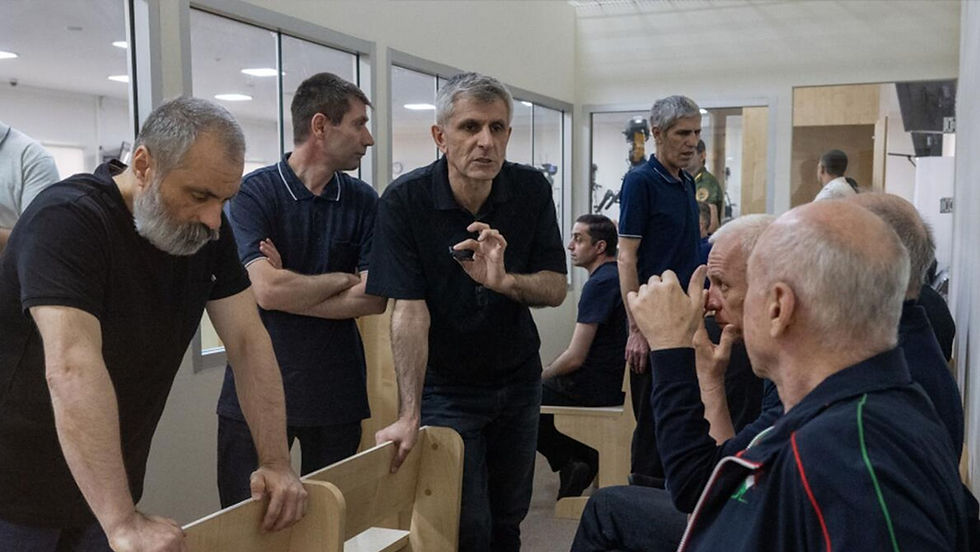
Rep. Vince Fong, R-Calif., said Azerbaijan continues to hold 19 Armenians, among them former political and military leaders of Artsakh.
“We must call for the immediate and unconditional release of all Armenian hostages and POWs whose unlawful detention and reported mistreatment remain a barrier to lasting peace,” Fong said.
Rep. Jim Costa, D-Calif., said the detainees and other unresolved humanitarian issues cannot be separated from efforts to establish lasting peace between Armenia and Azerbaijan.
“You can't have a lasting peace ... unless you have justice, unless you have accountability, unless you have a respect for fundamental human rights,” Costa said.
Costa called for the prisoners' immediate release, protection of Armenian cultural and religious heritage and the safe return of displaced Armenians.
The right of return was a central theme throughout the evening.
Rep. David Valadao, R-Calif., cited a November 2023 order from the International Court of Justice requiring Azerbaijan to ensure that people who fled Nagorno-Karabakh after Sept. 19, 2023, and want to return can do so safely, without obstruction and without delay.

“It's past time for Azerbaijan to follow that order,” Valadao said. “A lasting peace cannot mean leaving these people behind or asking Armenian families to simply accept that they can never return to their homes.”
Rep. Rashida Tlaib, D-Mich., described the events as ethnic cleansing and drew a connection to the experiences of her Palestinian American community.
“It's been three years since the ethnic cleansing of Armenians from Artsakh by Azerbaijan,” Tlaib said. “There has been no justice. There's been no return of displaced families.”
Two California lawmakers who visited Artsakh before the 2023 exodus, Reps. Judy Chu and Laura Friedman, reflected on what has happened to the region's Armenian population.
Chu, who traveled there in 2019, recalled seeing communities where Armenians were “thriving and proud.”
“It breaks my heart to consider that those people I visited just a few years ago are now refugees in Armenia,” she said.
Friedman called for the unconditional release of Armenian prisoners, an end to U.S. military assistance to Azerbaijan and stronger guarantees for Armenia's sovereignty.
“Peace has to start with accountability, lasting security and respect for sovereignty,” Friedman said.
Rep. Jim McGovern, D-Mass., co-chair of the Tom Lantos Human Rights Commission, also called for international accountability and compensation for Armenians who lost homes, businesses and livelihoods.
“It is incredibly important for the sake of morality and justice that the United States and the international community work together to hold the government of Azerbaijan accountable for ethnic cleansing and forced displacement of ethnic Armenians from their homes,” McGovern said.
Lawmakers and Armenian clergy also raised concerns about the future of Armenian churches, monasteries, cemeteries and other cultural sites now under Azerbaijani control.
Rep. Brad Schneider, D-Ill., spoke beside a photograph by Artsakh photographer David Ghahramanyan showing the 2023 exodus. He focused on a young girl pictured among those leaving the region.
“I think of the responsibility we have on our shoulders to make sure that we can answer her question, that what's happening is wrong, shouldn't have happened,” Schneider said.
He called for Armenian prisoners to be reunited with their families and for churches, monasteries, cemeteries and other sites documenting the Armenian presence in Artsakh to be protected.
Fong called for investigations into reported destruction of Armenian Christian heritage, while Chu urged the United States to oppose military and security assistance to Azerbaijan.
The Rev. Sarkis Aktavoukian, pastor of Soorp Khatch Armenian Church, offered a prayer for Armenian religious and cultural monuments.
“Lord, do not allow the memory of a people to be buried beneath the ruins of its heritage,” he said.
Siranush Sahakyan, an Armenian human rights lawyer representing prisoners and their families in international proceedings, used her keynote address to question what the Armenia-Azerbaijan peace process has delivered for those still held in Baku.
“What we are witnessing runs directly against the promise of peace,” Sahakyan said. “Prisoners remain detained while the safeguards protecting them and their families are being dismantled, deepening the suffering that a peace process should resolve.”

Sahakyan said the peace agreement initialed by Armenia and Azerbaijan in August 2025 contains no explicit commitment to release Armenian prisoners or guarantee the protected return of displaced Armenians.
She contrasted that with provisions addressing interstate legal disputes, arguing that the diplomatic process has established a timetable for ending litigation but not for bringing prisoners home.
Sahakyan also raised concerns about the loss of independent monitoring of Armenian detainees after the International Committee of the Red Cross closed its permanent delegation in Azerbaijan in September 2025.
She said her review of the judgment against Armenian businessman and former Artsakh state minister Ruben Vardanyan found that Azerbaijani authorities treated Artsakh's institutions as a criminal organization and used charitable activities among the evidence against him.
“If arrangements can be made for goods to cross borders, why can they not be made for a family to visit a prisoner and a consular representative to check his welfare or an independent lawyer to defend him?” Sahakyan asked.
During their meetings on Capitol Hill, ANCA advocates pushed several policy priorities, including enforcement of Section 907 of the FREEDOM Support Act, sanctions against Azerbaijani officials accused of war crimes, restrictions on U.S. assistance to Azerbaijan and congressional support for legislation addressing Armenia's security and potential sanctions against Azerbaijani officials.

ANCA Executive Director Aram Hamparian criticized the direction of U.S. policy, arguing that Washington risks accepting the displacement of Artsakh's Armenians as permanent.
“Current U.S. policy, sadly, is off course,” Hamparian said.
He argued that a peace process that leaves Armenian prisoners in detention, displaced families unable to return and allegations of war crimes unresolved risks creating conditions for future instability rather than lasting peace.
ANCA National Grassroots Director Gev Iskajyan said congressional action on Armenian prisoners, cultural heritage and the displaced population showed the effect of sustained Armenian American advocacy.
“None of those bills wrote themselves,” Iskajyan said. “They exist because advocates walked these halls and would not let Artsakh be forgotten.”
Archbishop Anoushavan Tanielian, prelate of the Eastern Prelacy of the Armenian Apostolic Church, closed the gathering with a message focused on maintaining the connection between displaced Armenians and their homeland.
“Artsakh is not history, Artsakh is not past,” Tanielian said.
The congressional gathering highlighted issues that remain unresolved three years after the region's Armenian population fled: the fate of Armenians imprisoned in Azerbaijan, whether displaced families will ever be able to return and what will happen to Armenian religious and cultural heritage left behind.
—
Support independent reporting from the region by subscribing to The Armenian Report. Our team is funded solely by readers like you.





Words like CRANE, SLATE, or TRACE maximize both letter-elimination bandwidth and exact-slot discovery on Turn 1. 5 Letter Words
Positional Entropy Over Raw Frequency: High-yield opening words are not merely anagrams of common letters like E, A, R, O, T
Spent way too long on Poki last weekend — started with one puzzle game and ended up trying like five different ones. Everything loads right in the browser which is nice when you just want something quick without installing anything. The variety is honestly what keeps me coming back.