
U.S. Vice President Deletes Armenian Genocide Reference After Tsitsernakaberd Visit

UPDATE:
Vance’s staff later said the original post referencing the Armenian Genocide was shared by mistake by team members who were not traveling on the vice president’s flight. A spokesperson for Vance stated, “This account is run by staff who mainly post photos and videos of the vice president. The vice president’s position on this issue can be found in his comments on the plane.”
Speaking to reporters right before boarding his plane to Baku, Vance addressed his visit to the Tsitsernakaberd memorial, saying: “We talked to the Armenians, they said this is a very important site for us. And obviously, I’m the first vice president to ever visit Armenia. They asked us to visit the site. Obviously, it’s a very terrible thing that happened a little over 100 years ago and something that is just very, very important to them culturally. So I thought out of a sign of respect both for the victims but also for the Armenian government that’s been a very important partner for us in the region to Prime Minister Pashinyan. I wanted to go and pay a visit and pay my respects.”

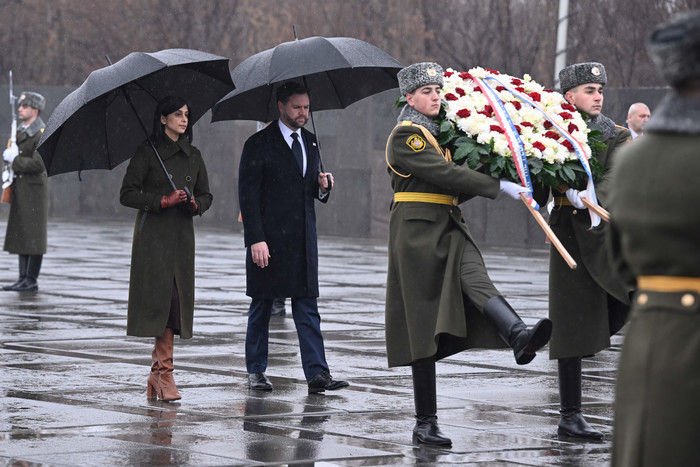
U.S. Vice President J.D. Vance visited Armenia’s Genocide Memorial Complex at Tsitsernakaberd on the morning of February 10, one of the final public events of his official trip to the country. However, attention quickly shifted from the visit itself to the handling of social media posts related to it, which sparked widespread criticism and public outrage.
Following the visit, a post appeared on Vance’s official X account explicitly referencing the Armenian Genocide. That post was later deleted. In its place, Vance’s account reposted a message from his press secretary, Taylor Van Kirk, which read: “@VP and @SLOTUS lay flowers at the eternal flame and sign the guest book on the final day of their visit to Armenia.” Notably, the revised version made no reference to the Armenian Genocide or to the victims commemorated at Tsitsernakaberd.

The original, now-deleted post had stated: “Today, Vice President Vance and Second Lady Usha Vance attended a wreath laying ceremony at the Armenian Genocide memorial to honor the victims of the 1915 Armenian genocide.” The removal of this wording became the focal point of criticism.

The deletion of the post and the omission of the term “Armenian Genocide” were widely viewed as deeply disrespectful to the memory of 1.5 million victims of the genocide and to their descendants. For survivors’ families and Armenians worldwide, recognition of the genocide is not a matter of semantics, but of historical truth, justice, and moral responsibility. Critics described the change as a painful dismissal of that legacy—particularly egregious given that it followed a formal visit to the memorial itself—reopening longstanding wounds tied to denial and political expediency.
The visit to Tsitsernakaberd took place under tight security. From early morning, roads and entrances leading to the memorial complex were guarded by police officers and members of the prime minister’s security staff. According to photographs released from the event, Vance and his wife were not accompanied by senior Armenian officials, and Prime Minister Nikol Pashinyan was not present.

Vance had arrived in Armenia on February 9 for an official visit. At Zvartnots International Airport in Yerevan, he was welcomed by National Assembly Speaker Alen Simonyan, Yerevan Mayor Tigran Avinyan, Deputy Foreign Minister Vahan Kostanyan, and Armenia’s Ambassador to the United States, Narek Mkrtchyan. Members of the U.S. delegation included Deputy Secretary of State for Economic Affairs Jacob Helberg. During his stay, Vance held talks with Prime Minister Pashinyan as part of a broader regional trip, and he is scheduled to depart for Baku later today.
The Armenian Genocide refers to the mass killing and deportation of Armenians by the Ottoman Empire beginning in 1915, during which an estimated 1.5 million Armenians were systematically murdered. The genocide is widely recognized by historians as the first genocide of the 20th century. Despite overwhelming historical evidence, Turkey, the successor state to the Ottoman Empire, continues to deny that the events constitute genocide, acknowledging deaths while rejecting intent. Turkey’s status as a key NATO ally of the United States has long influenced Washington’s cautious and often controversial approach to the issue.
For decades, the United States refrained from officially using the term “genocide” in reference to the Armenian case—a position widely seen by Armenians worldwide as a painful concession to geopolitical interests. That policy shifted on April 24, 2021, when President Joe Biden formally recognized the Armenian Genocide, becoming the first sitting U.S. president to do so. The announcement was welcomed globally as a long-overdue acknowledgment of historical truth.
Denial or non-recognition persists beyond Turkey. Azerbaijan, Turkey’s close ally, also rejects recognition of the Armenian Genocide, while Israel has not formally recognized it, despite repeated debates in the Knesset. These positions remain a source of deep anguish for Armenians, for whom recognition is inseparable from memory, dignity, and justice.
Against this historical backdrop, any retreat from explicit language acknowledging the Armenian Genocide—especially following a visit to Tsitsernakaberd—is seen by many Armenians as far more than a diplomatic adjustment. It is viewed as a continuation of a century-long struggle against denial and as a profound affront to the victims and to Armenians around the world.
—
Support independent reporting from the region by subscribing to The Armenian Report. Our team is funded solely by readers like you.




Comments