
Armenia Honors Women Killed by Domestic Violence as Officials Push for Stronger Protections
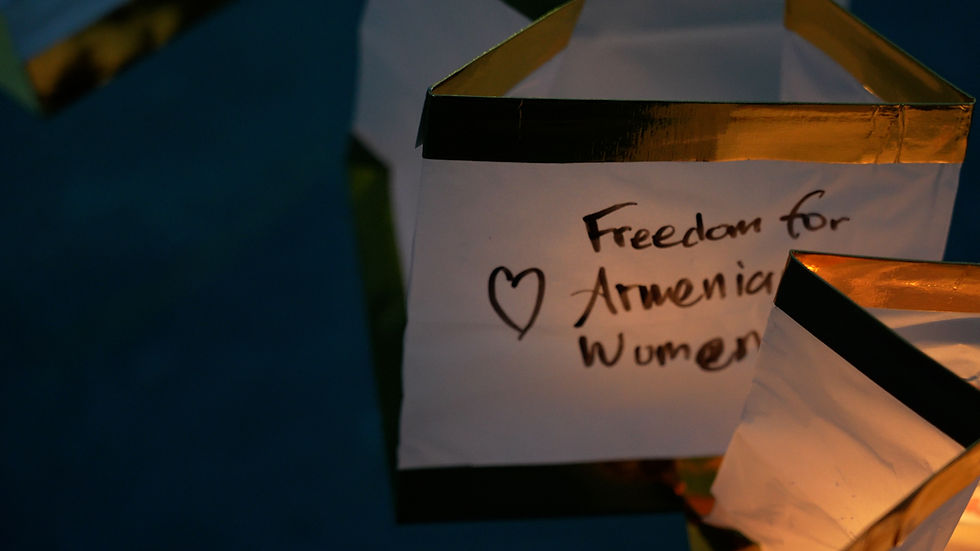
INTERVIEWS: Candles were lit along Yerevan’s Swan Lake on Thursday evening in memory of women killed by domestic violence, as government officials and rights advocates called for stronger protections and changes to how Armenia handles abuse inside the home.
The October 1 vigil, organized by the Coalition to Stop Violence Against Women, brought together activists, government officials and members of the public on Armenia’s National Day Against Domestic Violence. The most prominent figure in attendance was Prime Minister Nikol Pashinyan’s wife, Anna Hakobyan.
The Armenian Report attended the gathering and spoke with organizers and three government ministers about the scale of the problem, the support available to survivors and proposed legal changes that could allow authorities to pursue domestic violence cases even when a victim does not file a complaint.
For Lusine Sargsyan, communications specialist at the Spitak Helsinki Group, the gathering was first about the women whose lives were lost.
“We are here once again to remember all the women who have become victims of domestic violence and, through this annual action and initiative, to try to break the cycle of violence and make women feel more protected,” Sargsyan told The Armenian Report.
She said the goal goes beyond preventing individual cases of abuse.
“We want to have a society where women are valued, where women are economically empowered and where women are regarded as equal to men,” she said.
Health Minister Anahit Avanesyan said the consequences of domestic violence are regularly seen inside Armenia’s hospitals.
“We have patients who come to us with serious bodily injuries. We have children with serious bodily injuries. We even have women who end up in the hospital because they have been subjected to violence in their families,” Avanesyan told The Armenian Report.
Avanesyan said domestic violence cannot remain an issue discussed only behind closed doors. Changing the culture surrounding abuse, she said, requires both government action and greater public willingness to recognize and speak about it.
“It is the state’s responsibility to protect women and, more broadly, anyone who is subjected to violence,” she said. “This is a very sad situation, and we must no longer tolerate it — not in our society, not in our families and not in our wider communities.”
Labor and Social Affairs Minister Arsen Torosyan described the vigil as both an act of remembrance and a renewed commitment to prevention.
“We have gathered to remember cases of violence against women, to remember the victims and, most importantly, to renew our commitment — both publicly and to ourselves — to do everything possible so that no woman ever again becomes a victim of violence, let alone loses her life in her family or in any other environment,” Torosyan told The Armenian Report.
The most significant policy discussion of the evening came from Interior Minister Arpine Sargsyan, who acknowledged that Armenia’s official statistics still do not capture the full extent of domestic violence.
Sargsyan said authorities have recorded an increase in people reporting abuse in recent years, but existing rules can prevent law enforcement from moving forward in some cases unless the victim files a complaint.
“We still do not have the full picture reflected in our statistics,” Sargsyan told The Armenian Report.
She said authorities may not learn about abuse until a woman has experienced repeated violence.
A legislative package currently under consideration would change that system by moving domestic violence cases to public prosecution. If adopted, authorities could pursue a case once law enforcement becomes aware of suspected abuse, regardless of whether the victim files a complaint.
“Regardless of whether a complaint has been filed, if information about an incident becomes known to law enforcement through any means, we will initiate proceedings and move forward with the case,” Sargsyan said.
The proposal would also eliminate reconciliation as a way to end criminal proceedings in such cases and includes other changes aimed at strengthening protections for victims and accountability for alleged perpetrators.
Lawmakers discussed the package earlier Thursday but postponed its consideration for two months to allow additional proposals and revisions to be incorporated.
The timing placed the proposed reforms at the center of a day meant to confront a problem that activists have spent years trying to bring out of the private sphere and into public discussion.
At Swan Lake, however, the focus remained on the women who did not survive.
As participants stood beside the water and lit candles in their memory, organizers said the annual gathering was also a reminder that domestic violence is not simply a private family matter. For those gathered Thursday, remembering the women who were killed also meant asking what institutions and society can do before another life is lost.
—
Support independent reporting from the region by subscribing to The Armenian Report. Our team is funded solely by readers like you.


.png)
Comments