
Azerbaijani Official Mocks Armenian Christian Heritage at Gandzasar as Yerevan Remains Silent

Azerbaijani presidential adviser Hikmet Hajiyev disputed the Armenian identity of the centuries-old Gandzasar Monastery and mocked its manuscript heritage during a government-organized tour for foreign diplomats in Artsakh, indigenous Armenian land currently occupied by Azerbaijan, prompting anger in Armenia and growing calls for Yerevan to respond publicly.
Neither Prime Minister Nikol Pashinyan nor Foreign Minister Ararat Mirzoyan had commented on the episode as of Monday.
Hajiyev, a senior foreign policy adviser to Azerbaijani President Ilham Aliyev, visited Gandzasar with diplomats accredited in Azerbaijan and presented the medieval monastery as a monument of Caucasian Albanian heritage rather than an Armenian church.
During the tour, Hajiyev also stopped at an exhibition hall and opened books presented as Armenian manuscript displays. He pointed to blank pages while speaking sarcastically about Armenian Christian heritage. Several people in the diplomatic delegation could be heard laughing.
“Only one page ... the rest are blank. And this is the Christian heritage that you can see,” Hajiyev said with a smile.
Armenian cultural officials later said the books shown during the visit were replicas and that the original manuscripts are preserved in Armenia.
The episode has renewed concern in Armenia over the fate and portrayal of Armenian religious and cultural monuments in Nagorno-Karabakh, known to Armenians as Artsakh, after Azerbaijan took full control of the region in 2023 and its Armenian indigenous population forcefully fled.
Magdalena Grono, the European Union’s special representative for the South Caucasus, was among the diplomats who took part in the Azerbaijani-organized visit.
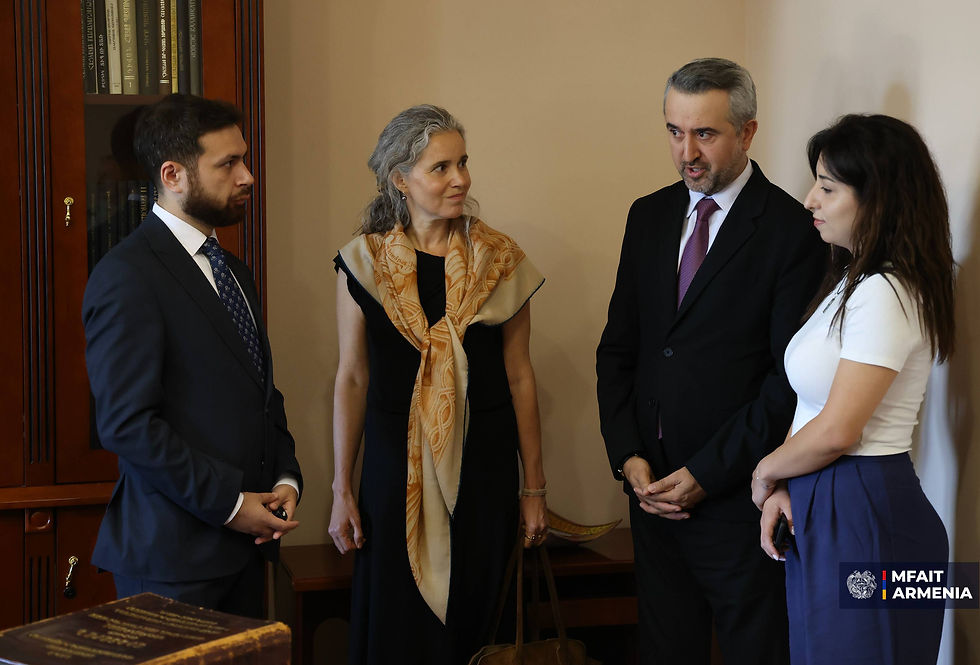
Following the tour, Grono said the Armenian and Azerbaijani sides continue to hold “deeply differing views and narratives regarding the origins of certain sites.”
Her comments drew criticism in Armenia, where critics said the issue should not be treated simply as a dispute between competing historical narratives.
The controversy reached Armenia’s parliament Monday, where opposition lawmaker Anna Grigoryan accused Azerbaijan of targeting Armenian cultural heritage after the forced displacement of Nagorno-Karabakh’s Armenian population.
Grigoryan, leader of the opposition Armenia faction, challenged National Assembly Speaker Ruben Rubinyan to state publicly that Gandzasar is Armenian.
“How do these actions bring us closer to establishing peace?” she asked. “Are you prepared to state your position that Gandzasar is Armenian? After all, thousands of young men did not die so that today you would be unable to say even one word that Gandzasar is Armenian.”
Rubinyan said the peace Armenia has achieved requires careful handling and sensitivity but acknowledged that the Azerbaijani statements were damaging.
“The statements you referred to naturally do not contribute to peace and are not helpful in the context of peace, in addition to being unfounded,” he said.
Edmon Marukyan, who previously served as ambassador-at-large under Pashinyan’s government, called on the prime minister and foreign minister to publicly declare that Gandzasar is Armenian and demand that Azerbaijan stop what he described as attacks on Armenian heritage.
“Demand that Azerbaijan stop these vile actions,” Marukyan said.
He also called on the Armenian government to send formal protest notes to the embassies whose representatives participated in the tour.
Marukyan argued that Azerbaijan’s treatment of Armenian cultural monuments should not be viewed in isolation. He warned that Baku was using historical and political narratives to lay the groundwork for future territorial claims against Armenia.
“Azerbaijan is building a military-political and legal-political foundation for attacking Armenia, taking Armenian territories and turning them into Azerbaijani territories,” Marukyan said. “No one should think there will be peace. There will not be.”
Lernik Hovhannisyan, a former culture minister of Artsakh, rejected Hajiyev’s presentation of the books as a manipulation.
Before the Azerbaijani occupation, Gandzasar housed a branch of the Matenadaran, Armenia’s repository of ancient manuscripts.
Hovhannisyan said valuable manuscripts and printed books kept there were moved to safety during the 44-day war in 2020. Replicas remained in the exhibition space.
“Hajiyev’s display is yet another manipulation,” Hovhannisyan told Azatutyun.
He also criticized the foreign diplomats present, saying they should have known the history of the collection and understood why the original manuscripts were no longer there.
“They understood very well and knew very well what had happened,” he said. “Grono herself, the other diplomats, and diplomats from the Minsk Group co-chair countries were also there. Were they unaware of this issue? Of course they were very well aware.”
Ara Khzmalyan, director of the Matenadaran in Yerevan, also rejected Hajiyev’s suggestion that blank books reflected the state of Armenian manuscripts connected to Gandzasar.
“There are no blank pages in our manuscripts,” Khzmalyan told Azatutyun.
He said original manuscripts were not kept permanently at Gandzasar because the facility did not have the security and conservation systems required to protect them.
Only copies were placed on display, he said, while the originals remained at the Matenadaran in Yerevan.
“The Matenadaran is ready to show them to any diplomat or ambassador who has even a 1% doubt about their authenticity,” Khzmalyan said.
Among the manuscripts associated with the Gandzasar collection is the Vehapar Gospel, which dates to 909 and is preserved at the Matenadaran, according to Khzmalyan.
Catholicos Aram I, head of the Armenian Catholicosate of Cilicia, also condemned the diplomatic tour and the presentation of Armenian churches and monuments as Caucasian Albanian heritage.
In a statement accompanying videos from the visit, Aram I said he watched the footage with “deep pain and outrage.”
He criticized foreign representatives for watching as Armenian religious and cultural monuments were presented under what he described as a false historical identity.
Aram I said the churches and monuments had stood for centuries as part of Armenian spiritual and cultural life and called their reinterpretation “a terrible distortion of history.”
He also warned that other parts of Armenian heritage could face a similar fate and described the developments as an “outrageous phenomenon,” which he partly attributed to Armenian “disunity and shortsighted policies.”
The dispute over Gandzasar comes as Armenia and Azerbaijan seek to consolidate a “peace process” after decades of conflict. At the same time, the episode has sharpened a separate question for Armenians: how religious and cultural monuments left under Azerbaijani control will be preserved, presented and identified in the years ahead.
—
Support independent reporting from the region by subscribing to The Armenian Report. Our team is funded solely by readers like you.




Comments